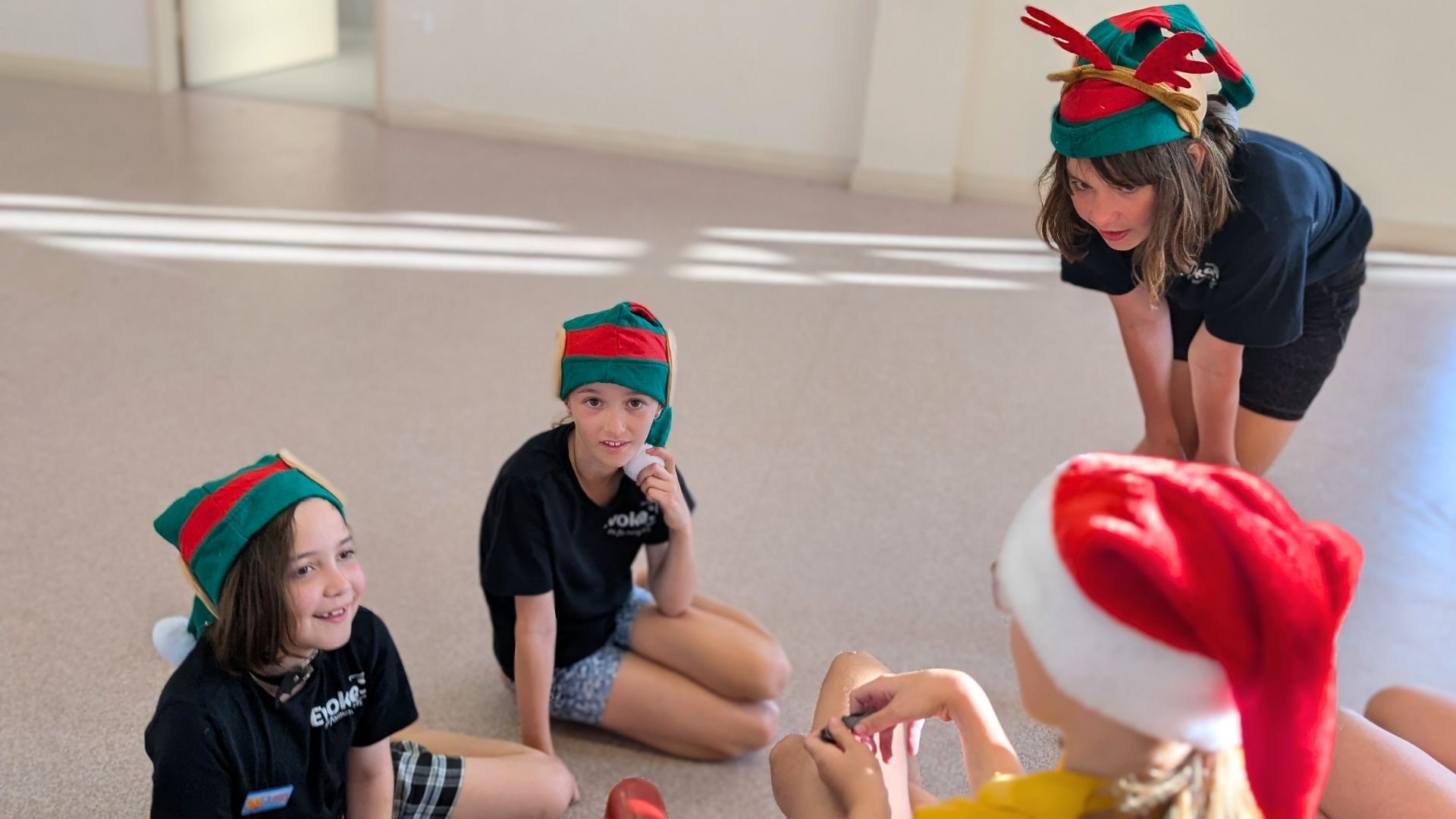
One of the questions I hear most, in car park conversations after a trial class and in late-night messages from parents who are still weighing it up, is some version of: "Will this actually make her or him more confident?" It's always asked with hope, and sometimes a quiet undercurrent of worry. Confidence feels like such an urgent thing when you're watching your child hold back at the edge of a birthday party, or go silent in a room full of people their own age. I understand exactly why parents want it for their children. I also know that you cannot hand it over directly. You can't give it in a class, a certificate, or even the warmest encouragement. But you can build it, one small experience at a time, in the right environment. And performing arts, after nine-plus years of teaching and psychology degrees that I use every single week, is one of the most reliably effective environments there is.
What confidence actually is (and isn't)
Many parents tell me they have a "not confident" child. But when I ask a few gentle questions, I usually find a child who is perfectly confident at home, or with close friends, or deep inside a pretend game they invented themselves. What they're describing often isn't a global lack of confidence. It's a lack of certainty that they are safe to be themselves in a new or unfamiliar space. That's a genuinely different thing, and it matters enormously, because it means the goal isn't to manufacture confidence from nothing. It's to create the conditions where what's already inside your child can come forward.
Psychologists call this self-efficacy, a term developed by Albert Bandura to describe a person's belief in their own ability to handle a situation or achieve a goal. Self-efficacy isn't a personality trait you're born with or without. It's built through direct experience: trying something, surviving it even imperfectly, and storing away the quiet message "I can do things like this." The tricky part is that to build self-efficacy, a child needs to take risks. Not big, overwhelming ones. Small, manageable ones, in a space that feels safe enough to wobble.
That's exactly what a well-run performing arts class is designed to be.
What's quietly happening in every class
Risk in a container
Every drama class is, at its heart, a series of small risks. A child raises their voice a little more than feels comfortable. They make a bold choice about how a character would move. They offer an idea in an improv game. They hold a moment of silence in front of their peers. Each one of these is a micro-challenge, and each one they move through quietly adds to their internal record of "yes, I can do hard things." It doesn't feel like therapy. It doesn't feel like a lesson. From the inside it feels like a game. But the effect is cumulative and very real.
Emotional vocabulary
Drama is one of the very few environments where children are actively invited to name and explore feelings, rather than just experience them and move on. When a child plays a character who is frightened, or triumphant, or devastated, they practise inhabiting those emotional states safely, from the outside in. Over time this builds what psychologists call emotional literacy: the ability to identify, name and understand feelings in yourself and in other people. Children who develop this skill tend to be better regulated, more empathetic, and more able to cope with difficult moments in everyday life. It is, quietly, a life skill that matters far more than any role they'll ever play.
The social rehearsal room
Group drama games are the most playful form of social skills practice I know of. Taking turns, reading a room, listening and responding to a partner, supporting a classmate when they blank on their line: all of this runs through every class. For children who find the social world confusing or exhausting, the structure of a drama class, play with gentle rules, creativity with support, is incredibly useful. They get to practise the difficult parts of being with other people without the stakes of the playground. It's training wheels for social confidence, and it works precisely because it doesn't feel like training at all.
The experience of being seen
This one is underestimated. For a shy or quiet child, simply standing in front of their peers and being looked at, even briefly, is a significant moment. We work up to it very gradually at Evoke, but when it happens, and when the world doesn't end, something shifts. The experience of being seen and having something good come of it, a laugh, a round of applause, a classmate's eyes lighting up, is one of the most powerful things I get to witness. The nervous system logs it quietly and deeply. It files it under: "I did that, and I was okay."
More than a stage skill
Here is the thing I most want parents to hear. The confidence children build in a performing arts class doesn't stay in the performing arts. It doesn't belong to the stage or the studio. I've watched it travel. Into the classroom, when a child puts their hand up for the first time in a term. Into the car, when a child says something out loud that they would normally have kept to themselves. Into a school presentation they not only survive but actually enjoy. Into a job interview at sixteen where they hold eye contact and speak clearly, not because they're performing, but because they've practised being seen.
The ability to take up space, use your voice, feel something and let it show: that is a skill that goes with a child everywhere. It belongs to them, not to any particular class or stage. And in my experience, once a child has had enough of those small moments of quiet bravery, the confidence simply starts to be who they are.
What I've seen over nine years of teaching
I bring my psychology background to how I structure every class, not because we run therapy sessions, but because understanding how children actually grow, how their nervous systems respond to challenge, how they build identity and manage emotion, means I can create an environment where the growth happens more reliably and more sustainably. It's why we start with games before we ever touch a script. It's why we follow the child rather than push the child. It's why a whisper counts just as much as a shout.
Some of the most confident young people I know came to me as children who would barely look up in week one. Not every transformation is dramatic or sudden. Many of them are simply the quiet accumulation of enough small wins over enough weeks that one day a parent says to me, "I don't know what's changed, but something has." That is exactly what is supposed to happen. That's the whole point.
If confidence is something you'd love to build in your child, I'd warmly invite you to come and see what that looks like in practice. A free trial class is the lowest-pressure introduction there is: no audition, no expectation, just a chance to come in, play, and see what happens. We'd love to welcome your family.